Did Vermeer use a camera obscura?
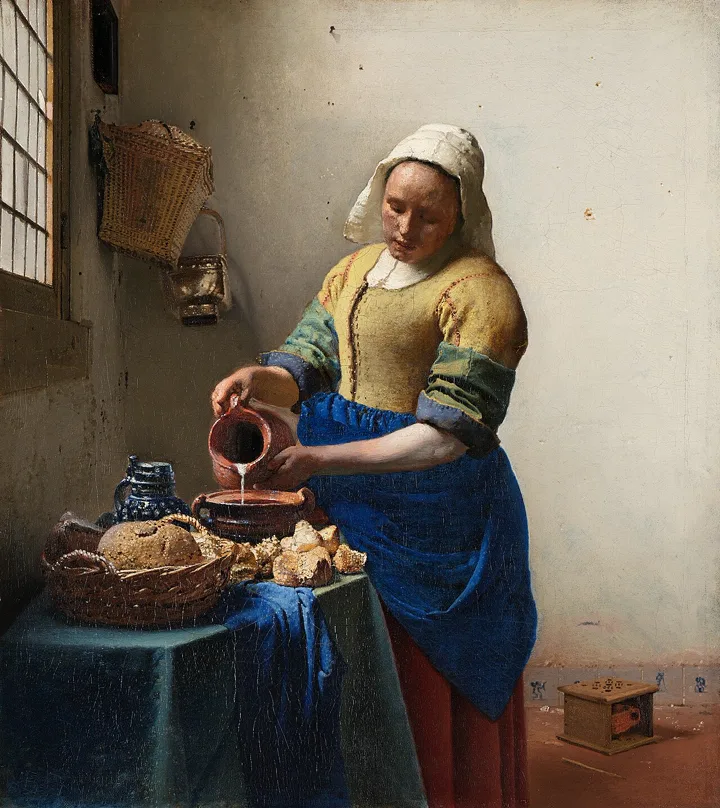
Johannes Vermeer (1632–1675) painted light so precisely that for more than a century people have asked whether he had help from optics. The short answer is that nobody knows for certain. No document shows that he owned or used a camera obscura. Even so, the paintings, the geometry of his studio and some modern experiments have convinced many researchers that he did. Here is what a camera obscura is, what the evidence says on each side, and why the question still matters to artists who trace with a projector today.
What is a camera obscura?
Camera obscura is Latin for "dark room." Let light into a darkened room or box through a small hole and an image of the scene outside appears on the opposite wall, upside down. Fit a lens in the hole and the image gets brighter and sharper.
The effect was known long before Vermeer. The scholar Ibn al-Haytham (c. 965–1040) studied it closely in his work on optics. In 1558 Giambattista della Porta described it in Magia Naturalis and suggested it could help people draw. In the early 1600s Johannes Kepler gave the device the name we still use.
The evidence that Vermeer used one
The way his paintings look. Look closely at the bread and the basket in The Milkmaid and you'll see small, soft dots of light. Lenses that are slightly out of focus turn bright points into blurry disks, which photographers call "circles of confusion." Supporters of the camera theory argue that Vermeer painted what he saw on a projected image, blur and all.
The geometry of his room. In Vermeer's Camera (Oxford University Press, 2001), the architecture professor Philip Steadman worked backward from the perspective in ten of Vermeer's interiors to rebuild the spaces they show in 3D. He concluded that they all show the same room, which he identifies as Vermeer's studio in Delft. In at least six of the paintings, the rectangle you get by extending the view back to the rear wall of that room is almost exactly the size of the canvas. Steadman's explanation is that Vermeer worked inside a booth-type camera obscura and the image fell on that back wall at the same size he painted it.
His neighbors. In his 2023 book Johannes Vermeer: Faith, Light and Reflection, Gregor Weber, head of fine arts at the Rijksmuseum, points to the Jesuits in Delft. Vermeer's wife came from a Catholic family close to them, and a Jesuit priest lived next door to the painter. The Jesuits were interested in the camera obscura as a way to study light. Weber argues this put the device within Vermeer's reach.
The evidence against
There is no paper trail. No camera obscura or lens appears in the inventory of Vermeer's possessions taken after his death. No contemporary account mentions him using one.
The pinholes. Conservators have found tiny holes at the vanishing point in a number of Vermeer's canvases. The conservator Jørgen Wadum suggested in the 1990s that Vermeer pushed a pin in there and stretched a chalked string from it to snap straight perspective lines onto the canvas. That method doesn't need optics at all. Steadman replies that a pin and string can give you the lines leading to the vanishing point, but not how big things should be as they recede, which is the harder problem.
He changed things as he painted. In 2022 the Rijksmuseum scanned The Milkmaid and found that Vermeer had first sketched a jug rack on the back wall and a willow fire basket at the lower right, then painted over both. The scans also showed a quick underpainting in light and dark tones beneath the maid's arm. Whatever he used to see, he was still composing the picture rather than copying a projection.
Even sympathetic historians tend to land in the middle. Vermeer may have studied the projected image to understand light, color and soft focus without tracing from it.
The Hockney–Falco thesis and Secret Knowledge
The question grew far bigger than Vermeer in 2001. The painter David Hockney began suspecting optics in 1999 after an exhibition of Ingres portrait drawings at the National Gallery in London. He worked with the physicist Charles Falco, and in Secret Knowledge: Rediscovering the Lost Techniques of the Old Masters (2001) Hockney argued that many European artists from the early 1400s onward used concave mirrors and lenses to project their subjects. This idea is now called the Hockney–Falco thesis.
Many art historians and scientists pushed back. They argued that the mirrors and lenses available would have been too small or too dim for the work described. Hockney's own position was that optics never made the masters lesser artists: a lens can project an image, but only a hand can draw the line.
Tim's Vermeer
In the documentary Tim's Vermeer (2013), directed by Teller and produced by Penn Jillette and Farley Ziegler, the Texas inventor Tim Jenison tests a simple idea. He places a small mirror above the canvas at a 45-degree angle, so he can see the reflected scene and his painting at once and match colors and tones one tiny patch at a time.
To test it, Jenison rebuilt the room from Vermeer's The Music Lesson at full scale, which took close to seven months. He then spent about four months painting his copy using the mirror. Steadman advised on the project. The film was distributed by Sony Pictures Classics, nominated for a BAFTA, and shortlisted for an Oscar.
The film doesn't prove that Vermeer used this setup. What it does show is that a patient person with a simple optical aid can get remarkably close to a Vermeer.
How artists use projection today
Whatever Vermeer did, artists today use projection openly. Muralists, sign painters and portrait painters project a reference onto the wall or canvas, lightly trace the main shapes, and then paint freehand. The projection saves hours of measuring and gridding. The painting itself is still the artist's work, which was Hockney's point too.
The modern version of the problem is that projectors rarely sit straight in front of the canvas. Tilt one up from a table, or place it off to one side, and the image turns into a trapezoid (this is called keystone distortion). The built-in keystone correction on most projectors only fixes part of that.
That's why we built Canvas Tracer. You open it in your browser on the laptop or tablet that's connected to your projector, drag four corner handles until the image sits exactly on your canvas from whatever angle, and it remembers that alignment for next time. You also get line art, grid and contrast tools to make tracing easier. It's the same idea Vermeer may or may not have used: let light do the measuring so you can spend your time painting.
Sources
- Philip Steadman, Vermeer's Camera: Uncovering the Truth Behind the Masterpieces (Oxford University Press, 2001). Summary: UCL News (December 2009); Steadman's own summary at WebExhibits
- David Hockney, Secret Knowledge: Rediscovering the Lost Techniques of the Old Masters (Thames & Hudson, 2001); Hockney–Falco thesis, Wikipedia; Charles Falco, "Art Optics," University of Arizona
- Tim's Vermeer (2013), dir. Teller: Wikipedia; Philip Steadman on the film
- Rijksmuseum, "Rijksmuseum reveals major discoveries on Vermeer's painting The Milkmaid" (press release, September 8, 2022)
- Gregor J.M. Weber, Johannes Vermeer: Faith, Light and Reflection (Rijksmuseum, 2023); coverage: Malay Mail / AFP, "Vermeer works inspired by pinhole camera, new book says" (January 8, 2023)
- Vermeer Centrum Delft, "Did Johannes Vermeer use a camera obscura or not?"
- Essential Vermeer, Steadman on perspective and the pin-and-string method
- Museo Galileo, "Camera obscura"